Make your design system useful to more people.
AI makes it easier than ever to turn an idea into a working prototype. But creating something that looks and behaves like a product isn’t the same as designing a good experience.
I help organizations build practical design systems and connect them to AI-assisted prototyping tools. This gives designers, product managers, and other team members a shared foundation to explore and communicate ideas using an established design language.
I also help teams establish ways to evaluate those ideas, improve the experience, and make informed decisions about what comes next.
CTA: Let’s Talk →
A better foundation for exploration
A design system captures the decisions that give a product its consistency: components, visual styles, interaction patterns, and the guidance behind them.
When that information is documented and made available to AI tools, it can help people create prototypes that reflect the product they’re actually working on.
Product managers can explore concepts without needing to design every screen. Designers can investigate interactions and alternatives. Developers can use the same foundations to understand design intent.
The goal isn’t to remove designers or developers from the process. It’s to make product exploration more accessible and give everyone a better starting point.
What I Can Help You Build
Every organization starts from a different place. Some need to establish their design foundations. Others have a working design system but want to make it more useful for AI-assisted prototyping.
I can help with either part or bring them together.
Design System Foundations
A practical foundation for consistent, reusable product design.
I build and improve design systems that capture the decisions behind a product and make them easier to apply. That includes the components, patterns, and documentation teams need to design consistently without repeatedly solving the same problems.
The goal is to establish something useful and maintainable, with room to improve as the product develops.
Capabilities
• Design tokens, components, and interaction patterns
• Design system architecture and documentation
• Audits and improvements to existing systems
• Guidelines for consistent application
• Design-to-development collaboration
AI-Assisted Prototyping
Helping more people explore product ideas within an established design language.
I connect design system documentation to AI-assisted prototyping tools so teams can create interactive concepts that reflect their product.
This includes preparing the design system for AI use, configuring the working environment, and developing examples that demonstrate how the tools can support product exploration.
The resulting prototypes can help teams communicate ideas, evaluate interactions, and investigate possibilities before committing to implementation.
Capabilities
• AI-ready design system documentation
• Prototyping environment setup and configuration
• Interactive prototypes and working examples
• AI-assisted exploration of product concepts
• Workflow documentation and team guidance
Design Review & Evaluation
Making room for the judgment that good design requires.
AI can produce a convincing interface without understanding whether it’s the right solution.
It can add unnecessary elements, assume functionality, or default to familiar patterns when a different approach might work better.
I help teams establish practical ways to review those decisions, explore alternatives, and identify what needs further consideration or testing.
These practices support the team’s existing product design process rather than replacing it.
Capabilities
• Problem framing and assumption review
• Evaluation of AI-generated prototypes
• Design critique and alternative exploration
• Usability and interaction assessment
• Guidance for validation and implementation readiness
Faster exploration still needs thoughtful design.
AI is good at producing plausible interfaces. It can draw on familiar patterns, fill gaps in a prompt, and assemble something that looks convincing.
But those decisions aren’t always appropriate.
A standard checkbox might work perfectly well. Or a different interaction might make the choices easier to understand. A familiar onboarding flow might be adequate, or reorganizing it could create a clearer, more engaging experience.
These opportunities aren’t always obvious from a working prototype.
Designers and developers still bring judgment that the tools can’t reliably provide. They can recognize unnecessary complexity, question assumptions, improve interactions, and identify better ways to solve the problem.
I believe AI-assisted prototyping is most useful when it creates more opportunities for that work, rather than encouraging teams to skip it.
An approach that fits your team
I start by understanding your product, existing tools, team, and goals. From there, we can define an engagement around what you actually need.
Establish the foundation. Build or improve the design components, patterns, and documentation that support consistent product experiences.
Enable exploration. Connect those foundations to an AI-assisted prototyping environment and show your team how to use it.
Support good decisions. Introduce practical review and evaluation methods that help your team move from promising concepts to better-considered solutions.
Depending on the engagement, I’ll also document the workflow and work through examples with your team so they have a useful starting point after the project ends.
We’ll agree on the scope, deliverables, and timeline before we begin.
See the approach in practice
Fringe Product Design System
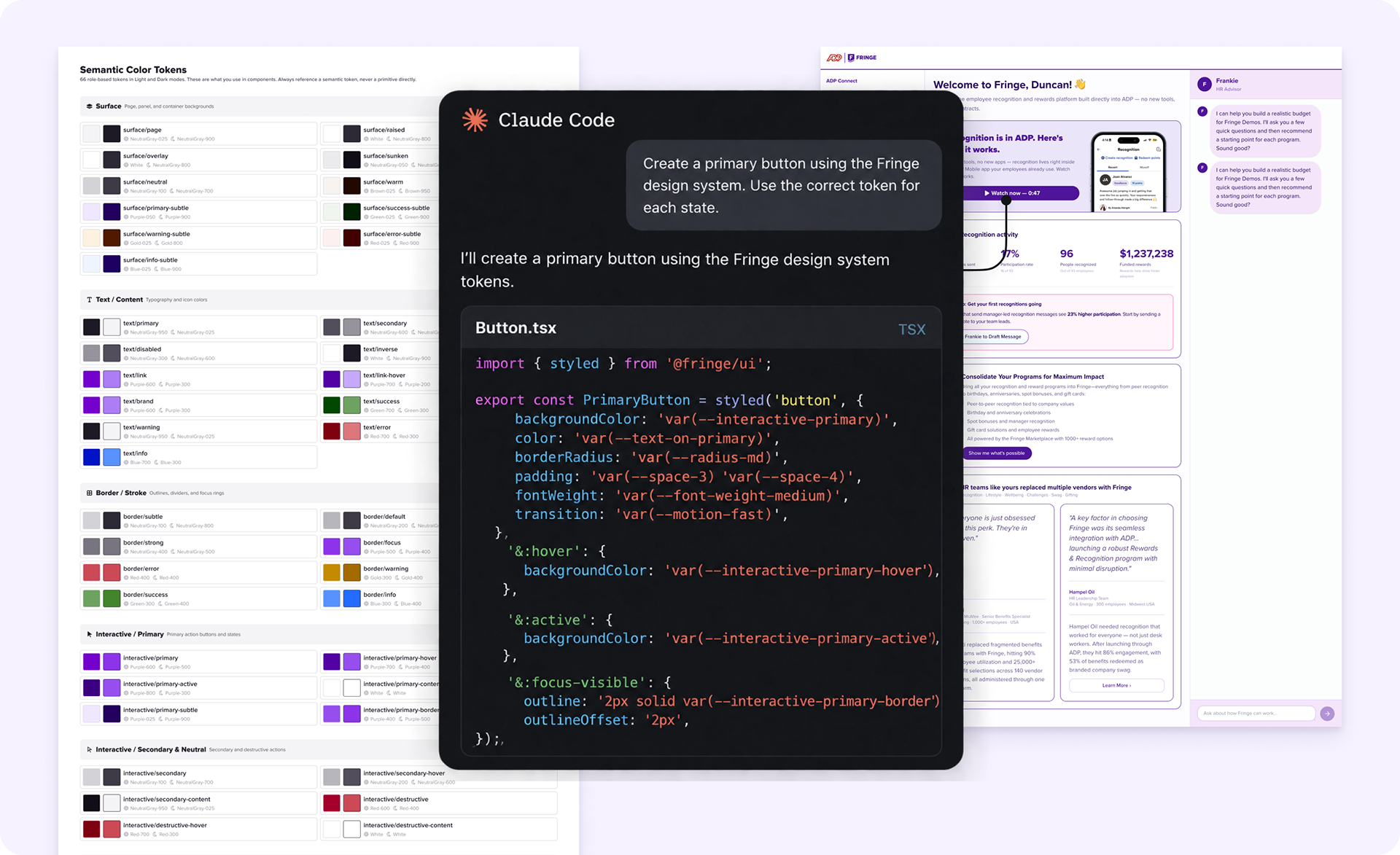
At Fringe, I developed a product design system that brought together design tokens, reusable components, interaction patterns, and documentation.
I also connected the system’s documentation to AI-assisted prototyping tools, making it easier for people across the organization to explore ideas using an established design language.
The work reinforced something I consider especially important: making ideas easier to produce is valuable, but the quality of the decisions that follow still matters.
Let’s talk about what you’re building.
Whether you’re starting a design system, improving an existing one, or exploring how AI might fit into your product development process, I’d be happy to learn more.
We can discuss what you’re trying to accomplish, where your team could use support, and what a practical engagement might look like.